How to Start a Career in AI and Machine Learning in 2026
Learn how to start a career in AI and Machine Learning in 2026 with a beginner-friendly roadmap covering Python, mathematics, SQL, data analysis, machine learning, deep learning, Generative AI, essential skills, courses, and practical projects.
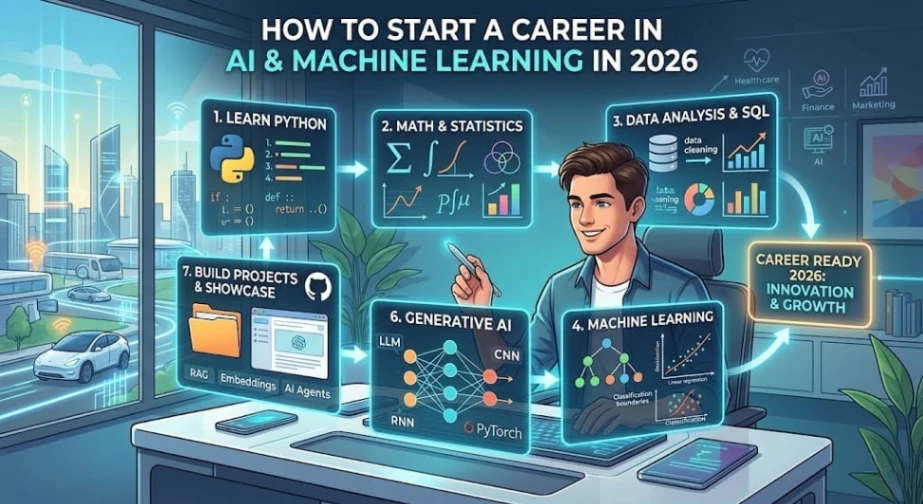
How to Start a Career in AI and Machine Learning in 2026
Artificial Intelligence (AI) and Machine Learning (ML) are among the fastest-growing technology fields in 2026. Companies are using AI for automation, data analysis, customer service, software development, healthcare, finance, marketing, and many other areas.
For students and freshers, AI/ML offers many career opportunities. But beginners often have one question: Where should I start?
The best approach is to learn the fundamentals step by step, practice with projects, and gradually move toward advanced AI technologies.
AI/ML Roadmap for Beginners
If you are completely new to AI and Machine Learning, follow this simple roadmap.
Learn Python
Python is one of the most commonly used programming languages in AI and ML.
Start with:
Variables and data types
Conditions and loops
Functions
Lists and dictionaries
Basic object-oriented programming
After learning Python basics, explore libraries such as NumPy, Pandas, Matplotlib, and Scikit-learn.
Learn Mathematics and Statistics
You do not need advanced mathematics in the beginning. Learn the basic concepts required for understanding machine learning.
Focus on:
Mean and median
Probability
Variance and standard deviation
Correlation
Basic linear algebra
Basic calculus
These concepts help you understand how machine learning models work.
Learn Data Analysis and SQL
AI and ML depend heavily on data.
Learn how to:
Clean data
Analyze datasets
Handle missing values
Visualize data
Find patterns in data
Write basic SQL queries
Learn Machine Learning
Once you understand Python and data, start learning machine learning.
Focus on:
Supervised learning
Unsupervised learning
Regression
Classification
Clustering
Model evaluation
Overfitting and underfitting
Practice these concepts by building simple ML projects.
Learn Deep Learning
After learning basic machine learning, move to deep learning.
Learn:
Neural networks
Activation functions
Training and testing
CNNs
RNNs
Transformers
You can later learn frameworks such as PyTorch or TensorFlow.
Learn Generative AI
Generative AI is an important part of modern AI development.
Beginners should understand:
Large Language Models (LLMs)
Prompt engineering
Embeddings
RAG
AI APIs
AI agents
After learning these concepts, build simple AI applications to gain practical experience.
Simple AI/ML Roadmap
Python → Mathematics & Statistics → SQL & Data → Machine Learning → Deep Learning → Generative AI → Projects
Best AI Courses for Beginners in India
The best AI course depends on your current knowledge, career goal, budget, and learning style.
Beginners can choose from different types of AI learning programs.
1. Online Self-Paced Courses
Self-paced courses allow you to learn according to your own schedule.
They are suitable for students and working professionals who can study independently.
Look for courses covering:
Python
Data analysis
Machine learning
Deep learning
Generative AI
Practical projects
2. University and Academic Programs
Universities and educational institutions offer AI, Machine Learning, Data Science, and related programs.
These are suitable for learners who want a deeper academic foundation.
3. Government AI Learning Programs
Government-supported platforms and initiatives can be useful for beginners who want to understand AI fundamentals before moving into advanced training.
4. Mentor-Led AI Courses
Mentor-led programs provide structured learning with guidance from instructors.
For beginners, look for a course that provides:
Live or guided learning
Practical projects
Updated AI curriculum
Generative AI training
Project guidance
Career preparation
What Should You Check Before Choosing an AI Course?
Before enrolling, check whether the course includes:
Python + Machine Learning + Deep Learning + Generative AI + Projects + Deployment
Avoid choosing a course only because it provides a certificate. Practical skills and projects are important when preparing for an AI/ML career.
AI/ML Skills Every Fresher Should Learn
Freshers do not need to learn every AI technology available. Focus on the most important skills first.
1. Python
Learn Python programming and the libraries commonly used for AI and ML.
2. Mathematics and Statistics
Understand basic statistics, probability, linear algebra, and the mathematical concepts used in ML.
3. SQL
Learn how to retrieve, filter, and analyze data from databases.
4. Data Analysis
Learn data cleaning, visualization, exploratory data analysis, and basic feature engineering.
5. Machine Learning
Understand common algorithms such as:
Linear Regression
Logistic Regression
Decision Trees
Random Forest
K-Means Clustering
Also learn how to evaluate ML models.
6. Deep Learning
Understand neural networks and basic deep learning concepts.
7. Generative AI
Learn the fundamentals of:
LLMs
Prompt engineering
RAG
Embeddings
AI APIs
AI agents
8. Git and GitHub
Use GitHub to store and showcase your AI/ML projects.
9. Problem-Solving
AI/ML professionals need to understand problems, work with data, select suitable models, and explain their solutions clearly.
10. Practical Project Development
Build projects while learning. Projects help you apply your knowledge and create a portfolio for internships and jobs.
Ready to make your next move?
Explore our mentor-led, industry-ready programs and turn what you just read into a career.
More from the Journal
Data Analyst vs Data Scientist: Difference & Which to Choose
The real difference between a data analyst and a data scientist - roles, skills, salary, and which one to choose in 2026.
How To Build a Career in Full Stack Development
If you want to build a career in software development, learning Full Stack Web Development can be a strong starting point.